At the Threshold - Dartmoor, Ostara & the Quiet Initiation of Spring
There are moments in the year that do not ask to be rushed… they ask to be crossed. Ostara is one of them. I returned recently from a few days held within the ancient, open landscapes of Dartmoor, a place where time feels loosened, where the land does not speak loudly, but deeply. It is not a landscape that performs for you. It waits. It watches. And, if you soften enough, it receives you. This journey was not about seeking something new, but about stepping across a threshold, from Winter’s inward gaze into the gentle awakening of Spring. And yet, something within me did shift.
Mary-Ann Robinson
3/26/20264 min read
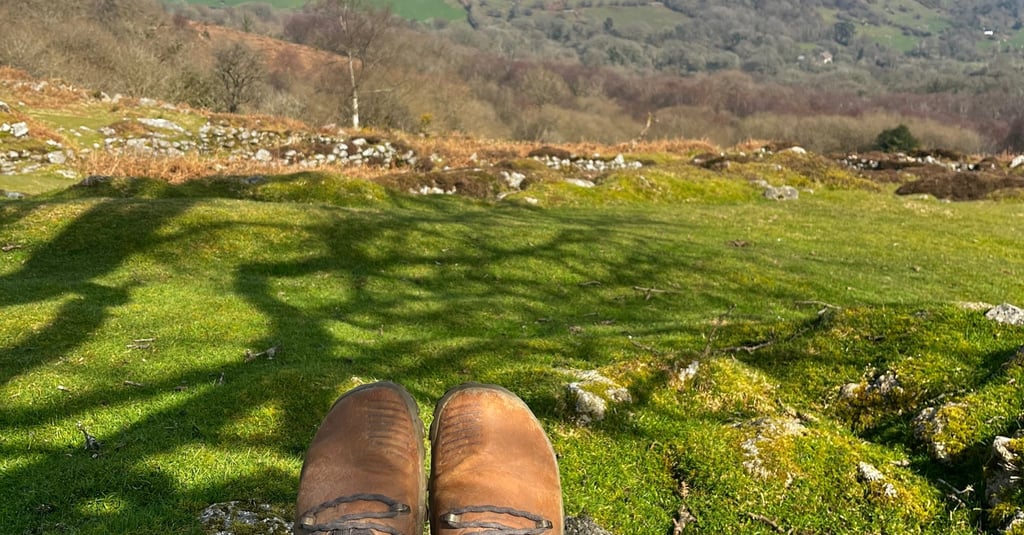
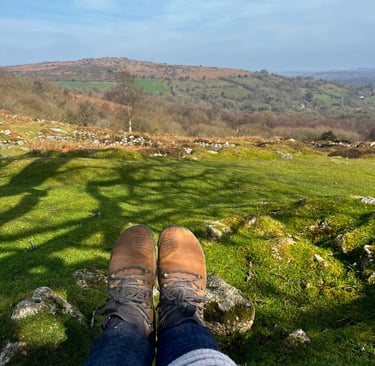
Ostara, the Spring Equinox, marks a moment of delicate balance, where day and night stand as equals before the light begins its gentle return. Rooted in ancient seasonal traditions, it is a time of renewal, fertility, and quiet awakening, when the earth begins to stir from winter’s rest. Across folklore and nature alike, symbols of new life emerge: lengthening days, budding leaves, and the subtle yet steady rise of warmth. Rather than a sudden shift, Ostara invites us into a threshold space... a pause between what has been and what is beginning to unfold.
Nature as Threshold, Not Backdrop
We often speak about time in linear terms: winter ends, spring begins. But nature does not move like that.
It unfolds.
In Dartmoor, that unfolding was visible everywhere. In the subtle greening of moss, the birdsong threading through the morning air, the quiet insistence of life returning. But more than that, it was something I could feel within my own body. This is where nature connection moves beyond something poetic and becomes something physiological.
Research into forest bathing (Shinrin-Yoku) shows that time spent in natural environments can lower cortisol levels, regulate the nervous system, and increase parasympathetic (rest-digest) activity. But beyond these measurable effects, there is something less easily quantified… a sense of recalibration.
A remembering.
When we step into wild spaces, especially landscapes as ancient and untamed as Dartmoor, the body begins to orientate itself differently. Heart rate slows. Breath deepens. Attention softens.
We are no longer pushing forward.
We are arriving.
Where Folklore Walks Beside You
Dartmoor is not only shaped by wind and stone, but by story. There is a quiet understanding here that the land is inhabited, not just by what we can see, but by what has been carried through generations in whisper and myth.
The wild ponies, moving freely across the moor, felt like more than animals in that moment. There is an old belief that such creatures are guardians of threshold spaces, guides between worlds, carrying an ancient, untamed wisdom. Watching them move with quiet certainty across the land, I felt a gentle reminder: not everything needs to be controlled to be known.
And then, there are the hares of Widecombe-in-the-Moor. Hares have long been woven into British folklore as liminal beings, shapeshifters, messengers, creatures of the in-between. In some traditions, they are said to move between the physical and the unseen, particularly at turning points of the year.
In the heart of the village, the church of St Pancras (often known as the Cathedral of Dartmoor) holds a quiet echo of this symbolism. Carved into its ancient roof beams is the motif of three hares, chasing one another in an endless circle, each sharing an ear with the next. This ancient symbol appears across sacred sites and is often associated with cycles, continuity, and the eternal turning of life, death, and rebirth.
To witness this, or even to know it is there, feels like a quiet affirmation of the season itself. A reminder that this threshold we cross at Ostara has been honoured for centuries… not only in ritual, but in story, in symbol, and in the very bones of the land.
The Initiation of Slowness
One of the quiet lessons of this Ostara was this: you cannot rush a threshold.
In a world that celebrates productivity and forward motion, choosing to move slowly can feel unfamiliar, even uncomfortable. But nature does not respond to urgency. It responds to presence.
During my time on the moor, I found myself lingering longer than usual, sitting beside streams, tracing the textures of stone, watching the shifting light across the land.
These moments may appear simple, but they hold profound value.
Studies in environmental psychology suggest that this kind of soft fascination, where attention is gently held by natural surroundings, allows the brain to recover from cognitive fatigue. It restores clarity, creativity, and emotional balance.
In other words, stillness is not inactivity.
It is restoration.
Ritual Without Performance
Ostara is often associated with renewal, fertility, and outward expression… but this year, my rituals were quieter.
A cup of herbal tea, prepared slowly and held with intention.
A moment of stillness beneath open sky.
A gentle acknowledgement of the turning season.
There was no need for elaborate ceremony.
Because the land itself was the ritual.
This is something I return to again and again within my work… the idea that ritual does not need to be performed for nature. It can be experienced with it.
And in doing so, something shifts.
We move from observer to participant.
Crossing Into Spring
As I leave this threshold behind and step more fully into the energy of Spring, I carry something subtle but steady with me.
A softened pace.
A deeper breath.
A quieter awareness.
And perhaps too, a quiet trust in what cannot always be seen: the unseen threads of story, instinct, and ancient rhythm that continue to guide us, just as they always have.
This is the true gift of nature connection, not just the moment itself, but the way it continues to ripple through us long after we have returned home.
Ostara is not a single day.
It is a doorway.
And once crossed, it asks only one thing: How will you carry this forward?
A Gentle Invitation
As the season begins to unfold, I invite you to find your own threshold moment. It does not need to be a journey to wild moorland or ancient landscapes. It can be as simple as stepping outside, pausing, and noticing:
The light.
The air.
The quiet signs of change.
Allow yourself to slow down. Allow yourself to arrive.
And allow nature (and perhaps a little of its mystery) to meet you there.
Wishing you the most wonderful Spring, Mary-Ann x
Your sanctuary is waiting.
© 2026 All rights reserved
Built with Harmony & Light
The Wild Sanctuary
Also connect with us on social media:
Instagram & TikTok @the_wildsanctuaryuk
A quiet walk. A quiet gathering. A quiet moment.